
Bridging the Time Gap: What “Durability” Means for Carbon Removal in Farm Landscapes
In the world of carbon dioxide removal (CDR), “permanence” is the gold standard. It asks: once carbon is removed from the atmosphere, how long will it stay sequestered? But there is another equally important question of time: what is the time lag between deployment and carbon removal?
The climate impact of any CDR strategy depends both on whether carbon stays in the ground and on when atmospheric concentrations actually begin to decline. Timing is particularly crucial on working lands. In agricultural landscapes, carbon removal is a process, governed by mineral dissolution and soil buffering. Whether through soil organic carbon accumulation or enhanced rock weathering (EW), the measurable drawdown of CO2 often unfolds over years or decades rather than seasons.
This creates a practical accounting dilemma. If two pathways ultimately store carbon for the same duration, but Pathway A delivers its benefit today while Pathway B reaches its peak in twenty years, should both A and B get the same carbon credits today?
Current market frameworks often ignore delays in carbon capture, treating all methods as equivalent to immediate technologies like Direct Air Capture (devices that pull CO2 directly out of ambient air and store it, described here on page 41). However, as highlighted in a recent preprint study by Planavsky et al., treating durability without reference to time lags and the unique time-profiles of land-based solutions can flatten important differences and obscure the very processes that make soil-based removal viable.
“…we suggest that coupling enhanced weathering and biochar with point-source methane emissions reductions provides a robust crediting framework for carbon credits that can continuously-and immediately-offset anthropogenic emissions.”
— Planavsky et al.
To bridge the gap, Planavsky’s team proposes a new accounting framework. By introducing metrics that value the time frame of storage, we can finally ensure that agricultural solutions are counted fairly, scaling at the pace the climate crisis demands.
The Science
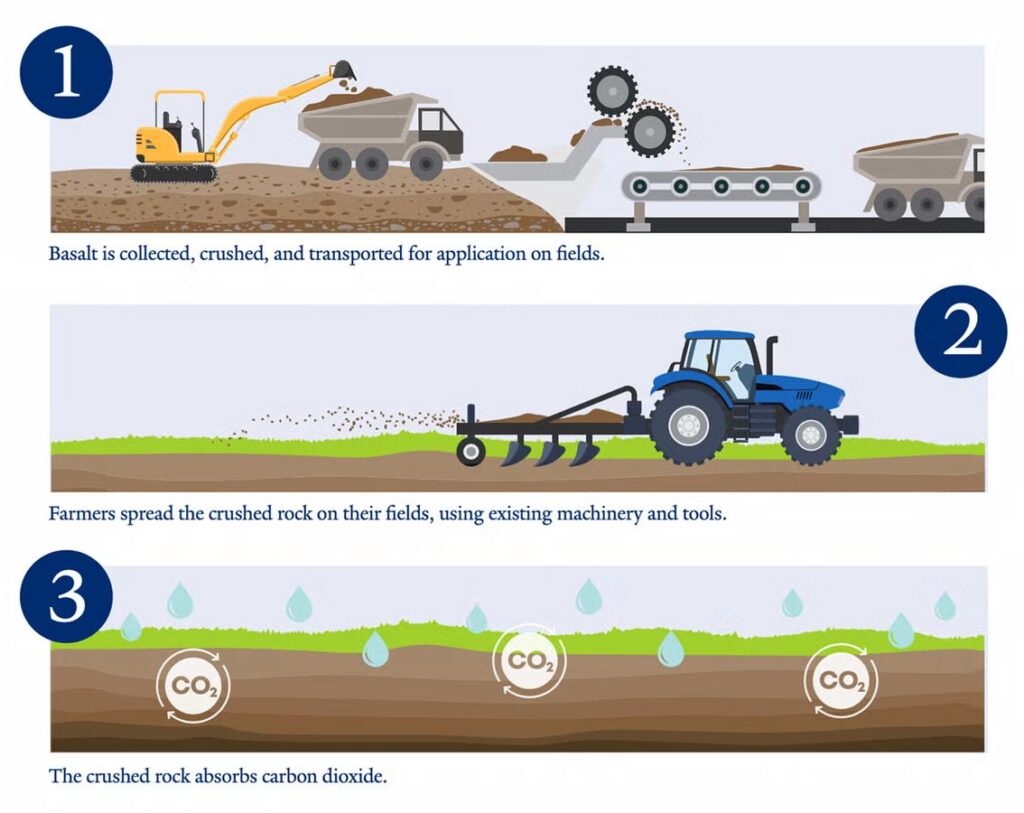
At the heart of the challenge is the physical reality of time lag. In technologies like direct air capture, the CO2 is sucked out of the sky the moment the fans turn on. But on working lands, the process is slower. When applying basalt rock dust to a field for enhanced weathering (EW), the carbon removal depends on the rock dissolving and the ions traveling through the soil into the ocean, a journey that can take years.
In their latest study, Planavsky and his team argue that our current way of valuing carbon credits fails to reflect the intervening radiative forcing: the actual warming or cooling effect on the planet. It thus creates a disconnect between policy-based accounting and the physical reality of the carbon cycle. If a project will remove a ton of CO2 but that removal won’t be fully realized for 20 years, the climate is still warming during those two decades.
Planavsky’s framework proposes that the value of a carbon credit should be adjusted to reflect this. The researchers introduced a four-step process accounting for time, summarized in Table 1. Think of it as a delay penalty.
| Steps | Notes |
| 1) Empirically constrain the extent of rock dissolution—e.g., measure the initial CDR rate. | Dissolution rates can vary considerably; private and academic efforts are exploring ways to determine accurate, efficient, and scalable methods to measure EW dissolution rates from field deployments. |
| 2) Estimate the CDR lag time linked to cation sorption. | Methods for estimating CDR lag times are still developing, but there is a first attempt at estimating lag times and others will likely follow. |
| 3) Purchase methane credits to an extent commensurate with the radiative forcing reduction that would be experienced with no cation exchange lag. | This step would likely require concerted coordination between methane credit and EW suppliers, which are different entities in today’s voluntary carbon market. |
| 4) Mint ex-ante EW credits that are backstopped by the immediate methane reductions. | Credits could be minted after weathering has occurred but while cations are still largely on sorption sites. |
One of the most innovative suggestions in the study is a proposed bridge crossing the gap in time: coupling EW with other strategies. By pairing slower-acting long term removals like EW with immediate but short term actions (such as reducing point-source methane emissions), we can create a composite credit. This “hybrid” approach ensures that the atmosphere feels the cooling effect immediately while the long-term, permanent storage of the rocks matures in the background.
As the paper demonstrates through modeling, even slow-reacting mineral amendments can become high-value climate tools if their ultimate durability is high enough. This matters when the question is how much carbon capture we are delivering over the next century.
Implications for Land-Based CDR

The current carbon market is a race for speed. Technologies that offer “instant” removal, like direct air capture, often command a premium because their results are immediate and easy to count. For a farmer looking to implement soil-based solutions, this creates an uphill battle. If your basalt application takes ten years to reach its full potential, the market historically treats that delay as a weakness.
However, Planavsky’s research, by providing a rigorous way to account for and compensate for time lags, offers several game-changing implications for agricultural landscapes:
- A Level Playing Field for Farmers: Many of the most durable CDR methods, such as EW and deep-soil organic carbon sequestration, are inherently slow. With a time-weighted credit system and a hybrid approach, these practices can finally be valued fairly alongside high-tech engineered solutions. It moves the conversation away from “how fast” to “how long it will last.”
- The Power of Coupling: One of the most practical takeaways from the paper is the reimagination of credits. Hybrid carbon credits can combine the immediate cooling of methane reduction (like capturing leaks from a local gas well) with the permanent, long-term storage of rock weathering on a nearby farm. This backstop makes agricultural credits more attractive to buyers who need immediate climate impact but refuse to compromise on thousand-year durability.
- Incentivizing Early Action: Because the delay penalty is higher the longer you wait to start, this framework encourages land managers to act now. Treating soil remineralization as a whole-system service rather than just a carbon-yield game is essential. Planavsky’s math provides the financial justification for this holistic view.
For the carbon market to be truly effective, it must accept the physical reality of how the Earth moves. Being slow but durable should no longer be seen as a drawback, but as a multi-generational investment in planetary cooling.
Open Questions
While the logic of timing is scientifically sound, the process of incorporating it into a functioning market raises several critical questions.
How do we value the climate today versus the climate in fifty years? Time discounting is as much a political and ethical choice as it is a mathematical one. If we penalize delay too heavily, we might inadvertently stifle long-term solutions; if we don’t penalize it enough, we risk underestimating the immediate warming impact of CO2 still lingering in the air.
How do we quantify it? Monitoring, Reporting, and Verification (MRV) is the backbone of trust. For land-based CDR, this is notoriously difficult. As Planavsky et al. point out, estimating the delay between rock dissolution and actual CO2 drawdown is still an evolving science, relying on modelling. The market must decide if it trusts these modeled outcomes.
Will buyers and policymakers accept this kind of credit? Today’s voluntary carbon markets are fragmented, and methane credits and mineral weathering credits are sold by different entities. Bridging this fragmentation requires a level of coordination that doesn’t yet exist at scale.
These issues show a fundamental shift: we are moving away from fixed-asset accounting toward a more dynamic, “probabilistic” accounting that reflects the messy and slow-moving reality of our planet’s natural cycles.
The issue of timing determines which solutions scale and who benefits from them. If we continue to ignore the time gap, we risk leaving agricultural landscapes behind in the global push for net zero.
The ultimate benefit of soil remineralization lies in its ability to restore entire ecosystems. By adopting a framework that accounts for the physics of time, we can do more than just fix the carbon market. As we refine our tools to measure both, the work happening beneath our feet in the world’s farm fields may finally get the recognition, and the funding, it deserves.
Qi Zheng is an undergraduate student in Environmental Policy and Sustainable Development with Economics at the London School of Economics and Political Science. She is interested in climate policy, soil carbon sequestration, and sustainable land management, and is also exploring the intersections of environmental governance and economic development.
Support us on Patreon
Thank you for joining us today! Please become a member of RTE and support us on Patreon. Unlike many larger organizations, we work with a team of determined and passionate volunteers to get our message out. We aim to continue to increase the awareness of remineralization to initiate projects across the globe that remineralize soils, grow nutrient dense food, regenerate our forests’ and stabilize the climate – with your help! If you can, please support us on a monthly basis from just $2, rest assured that you are making a big impact every single month in support of our mission. Thank you!


Got something to say?