
Soil Remineralization Revisited: From Historical Practice to a Whole-System Approach

Professor Suzi Huff Theodoro with farmers in Bahia Brazil getting ready to add rock dust to their fields (from this video)
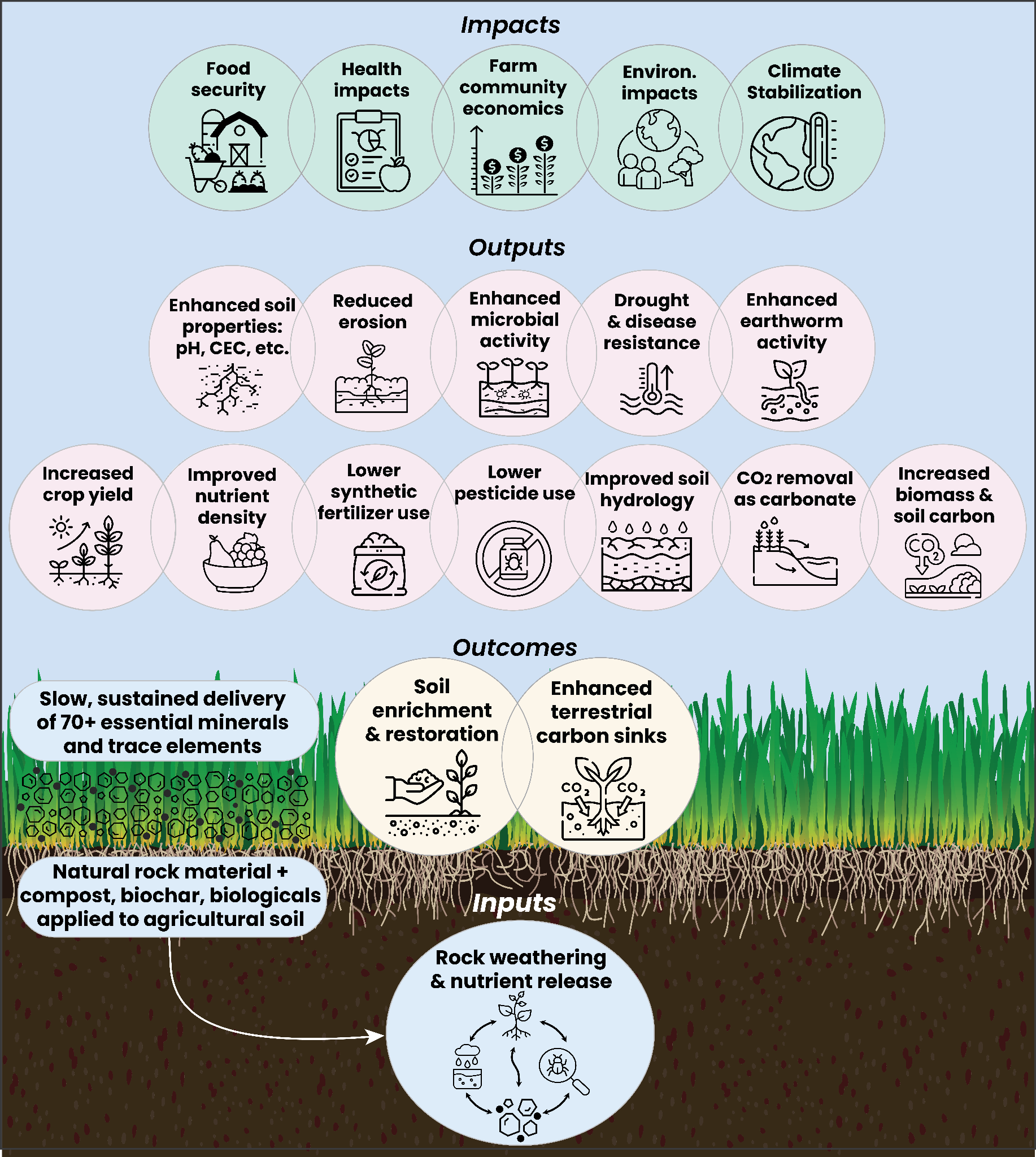
For millennia, farmers from the Nile Valley to the Brazilian Cerrado have used finely ground rock dust together with organic amendments to restore and enrich depleted soils. Over the past decade, this historical practice of soil remineralization (SR) has also become a focus of climate researchers because of its promise as a carbon dioxide removal strategy, known as enhanced rock weathering (ERW). That attention has generated a growing body of data on how rock weathering in soil removes carbon from the atmosphere and stores it in the geosphere while simultaneously improving soil properties. Although these ERW studies have provided a wealth of information, their narrow focus on carbon removal can unintentionally obscure the broader value of soil remineralization. Traditionally, soil remineralization has been applied as a form of geotherapy to enhance a broad suite of soil ecosystem services, rather than as the narrowly framed geoengineering approach reflected in some modern climate studies. This tension is explored in a comprehensive white paper from Remineralize the Earth (RTE), “Soil Remineralization in Agroecological Systems: A Critical Review,” recently posted on the preprint server EarthArXiv.
Drawing on biogeochemical theory, a deep history of on‑farm experience, and a new synthesis of nearly 200 experimental and field observations, the RTE white paper argues that when carefully implemented, soil remineralization can boost crop yields and nutrient density while reducing environmental impacts associated with synthetic fertilizers and pesticides. These findings support SR as an important agroecological strategy for food and nutrition security. The authors also caution that outcomes depend on a whole-system balance of mineralogy, biology, rock grain size, and metal toxicity thresholds over years and decades. They highlight evidence showing rock dust works best when combined with organic and biological materials (e.g., composts, biochar, and microbial inoculants) collectively referred to as “biomineral” amendments. This coapplication consistently outperforms rock dust alone for crop yields, root development, soil health, and carbon storage. Overall, the authors conclude that soil remineralization’s greatest potential lies in restoring a suite of ecosystem services: nutrient cycling, water regulation, biodiversity support, and long‑lived carbon storage. They caution, however, that poorly chosen rock types, excessive application rates, or carbon-offset-driven deployment can undermine both agroecological health and farmer trust.
Deep roots
Before examining the science, the white paper does something relatively rare in the technical literature: it traces soil remineralization as a continuous human practice stretching back five millennia. The authors argue that SR should not be understood simply as a novel climate intervention but as part of a longstanding agricultural tradition that has repeatedly resurfaced when farmers have sought ways to rebuild soil fertility in the absence of synthetic fertilizers. The authors open their historical survey with a fitting observation from the pioneering agronomist Ward Chesworth: “As with most good, simple ideas in agriculture, somewhere in the world a farmer can be found to have anticipated the scientist.”
The story begins in predynastic Egypt, roughly 5,000 years ago, where farming communities built dikes and canals to channel sediment-rich floodwaters across their fields. The waters carried fine volcanic rock particles eroded from the Ethiopian Highlands, depositing a natural, mineral-rich fertilizer that allowed large-scale cultivation of wheat, barley, and flax with little additional soil preparation. In Mesopotamia, farmers similarly channeled silt-laden waters from the Tigris and Euphrates to nourish their crops, sustaining some of the ancient world’s most productive early agricultural systems. The Aztec and Maya dredged mineral-rich sediments from canals to replenish the soils of their raised garden islands, and in India, an Indigenous practice called tank silt management, excavating clay-rich sediments from seasonal water catchments, has been used to improve soil fertility and moisture retention for generations.
By the Roman era, the naturalist Pliny the Elder was writing detailed recommendations for using different types of marl, a mix of silicate clay and carbonate rock, as agricultural amendments for cereals and pasture. He advised matching specific rock types to specific environments, cautioned against over-application, and noted that tuffaceous marl, likely a volcanic rock, worked best when co-applied with what he called “vegetable earth,” a type of compost. The white paper authors note that these are, remarkably, among the same best practices used in soil remineralization applications today.
The white paper further traces the SR tradition into medieval and early modern Europe. For example, English farming records from 1499 document a successful marl trial near Newton, in which a local landowner applied several tons of clay-rich rock to wheat and barley fields and recorded a two-fold increase in grain yields. By the Enlightenment, the practice had become a subject of scientific inquiry. In 1769, the chemist Johann Andreae analyzed nearly 300 marl-like rock types for agricultural potential, and James Hutton, the founder of modern geology, experimented with marl, seaweed, and compost on his Scottish farm. By the mid-1800s, the German chemist Heinrich Magnus had demonstrated that finely ground potassium feldspar produced healthier, more vigorous barley than salt-based fertilizers. In 1894, Julius Hensel synthesized this experimental SR work in his foundational monograph Bread from Stones, arguing that rock dust could serve as a primary, broad-spectrum fertilizer, a claim that would be tested and validated repeatedly over the following century.
The early twentieth century brought growing institutional attention. In 1907, the U.S. Department of Agriculture published a short monograph on feldspathic rocks as fertilizers, concluding that success depended on understanding the interplay of rock chemistry, soil conditions, and crop biology, the same whole-system insight that underpins the RTE white paper today. Subsequent American studies in the 1920s and 1940s confirmed that finely ground feldspar increased buckwheat yields and improved potassium availability through root action, reinforcing the essential role of plant biology in unlocking nutrients from rock. By mid-century, researchers in Mauritius had documented up to 20% yield increases in sugar cane following basaltic rock dust applications to exhausted tropical soils, and J.I. Rodale had connected the legendary health and longevity of Pakistan’s Hunza people to the glacial rock flour carried into their fields by meltwater, an observation later echoed by the eminent soil scientist William Albrecht.
The white paper also highlights that some of the most important modern SR research has come from Brazil, where highly weathered tropical soils make the case for remineralization especially compelling. Beginning in the 1950s, Brazilian researchers demonstrated that a wide range of locally available rock types could restore fertility and nutritional density to soils that conventional NPK fertilizers could not adequately rehabilitate. By the 1980s, these findings had contributed to a growing international consensus, articulated by geochemist William Fyfe, that tropical and equatorial soils require “slow-release, relatively insoluble, wide-spectrum fertilizers,” and that local rock products could provide much of what was needed. Foundational review articles by Fyfe, Chesworth, and Leonardos, as well as the pioneering work of geologist Peter van Straaten in the 1980s, compiled this evidence and helped establish agrogeology (geology in the service of agriculture) as a coherent interdisciplinary field.
It was largely this body of work, and particularly the 1982 synthesis by American farmer-ecologist John Hamaker and ecologist Donald Weaver in The Survival of Civilization, that inspired one of the white paper co-authors, Joanna Campe, to found Remineralize the Earth in the mid-1980s. Beginning as a network newsletter for SR researchers and practitioners, RTE grew into a U.S. nonprofit by 1995 and took on a leadership role in connecting researchers worldwide.
The white paper goes on to note that recent decades have brought increasingly rigorous scientific synthesis of the SR evidence base. A landmark 2017 review by Basak and colleagues demonstrated that pairing potassium-bearing silicate minerals with potassium-solubilizing microorganisms dramatically accelerates nutrient availability under field conditions, an early, rigorous validation of the biomineral approach. Building on this, Swoboda et al. (2022) confirmed that silicate rock powders show the greatest promise on strongly weathered soils in humid and subhumid tropical regions, precisely the agroecological zones of the Global South where affordable, locally sourced macro- and micronutrients are most urgently needed and least available through conventional fertilizers.
The past several years have seen a sharp acceleration in the rate of publications on soil remineralization, driven in part by growing recognition that silicate weathering is a credible carbon dioxide removal pathway, with enhanced rock weathering estimated to remove between 0.5 and 2 gigatonnes of CO₂ per year at scale. It is against this backdrop, a field grown from ancient on-farm observation to a globally active research enterprise, that the RTE white paper makes its central point. Rather than adding to the growing literature on carbon removal metrics, the authors step back to reassert the foundational principles that history has repeatedly validated: that SR works best as a whole-system practice, that rock dust combined with organic and biological amendments outperforms rock dust alone, and that the long-term promise of the field depends on careful implementation that prioritizes soil health, food security, and farmer trust alongside climate goals.
The evidence speaks
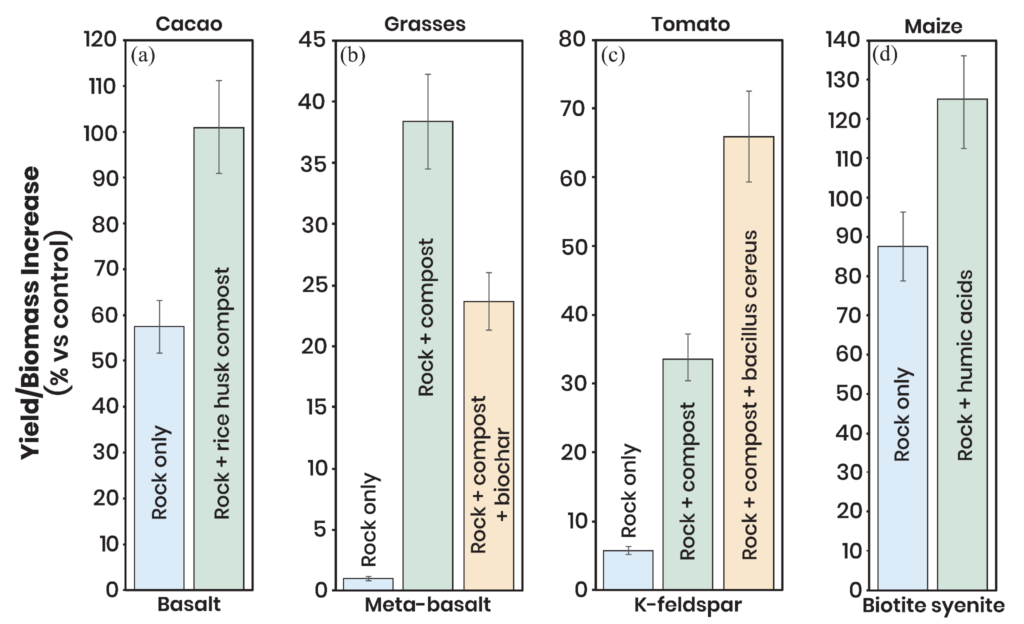
The white paper’s main technical contribution is its compilation of 190 experimental and field observations drawn from a representative database of peer-reviewed soil remineralization studies. Of those 190 observations, 87 percent showed increases in crop biomass or yield relative to controls. Among the 83 tests that analyzed plant material, 89 percent showed enhanced nutrient uptake. The paper presents these findings not as proof that rock dust always works, but as evidence that soil remineralization can be highly effective when rock type, soil condition, biology, and management are aligned.
The benefits described in the data synthesis extend beyond yield alone. The review summarizes evidence of improved soil fertility, broader availability of macro- and micronutrients, better soil structure, improved pH, reduced aluminum toxicity, enhanced water retention, and greater biological activity in remineralized soils. It also emphasizes that co-applications with compost, biochar, green manures, humic substances, or microbial inoculants outperform rock dust alone, which supports the paper’s broader claim that soil remineralization is most effective as a whole-system practice rather than a single-input fix.
Carbon finance and its limits
The white paper also touches on how carbon market incentives are shaping the design and deployment of soil remineralization through enhanced rock weathering. The concern is not with climate goals themselves, but with what happens when financing mechanisms reduce a multifunctional practice to a single auditable metric.
That distinction matters because incentives shape behavior. The paper warns that carbon-offset models can favor repeated high application rates and rock choices optimized for modeled carbon drawdown rather than for agronomic suitability or ecological safety. It cites evidence that repeated basalt applications at rates associated with some large-scale ERW scenarios could drive copper, nickel, chromium, and zinc concentrations toward or beyond regulatory thresholds within a decade. This risk is greatest when projects are optimized for carbon maximization rather than whole-system land stewardship.
The paper does not reject climate benefits. On the contrary, it recognizes that silicate weathering and healthier soils can contribute meaningfully to long-term carbon storage. But it argues that financing mechanisms will be more durable and more attractive to practitioners if they reward stacked outcomes such as better yields, improved nutrient density, reduced fertilizer dependence, water regulation, biodiversity support, and long-lived carbon sequestration, rather than treating soil remineralization as a one-dimensional offset technology.
Lessons from Brazil’s Central Plateau
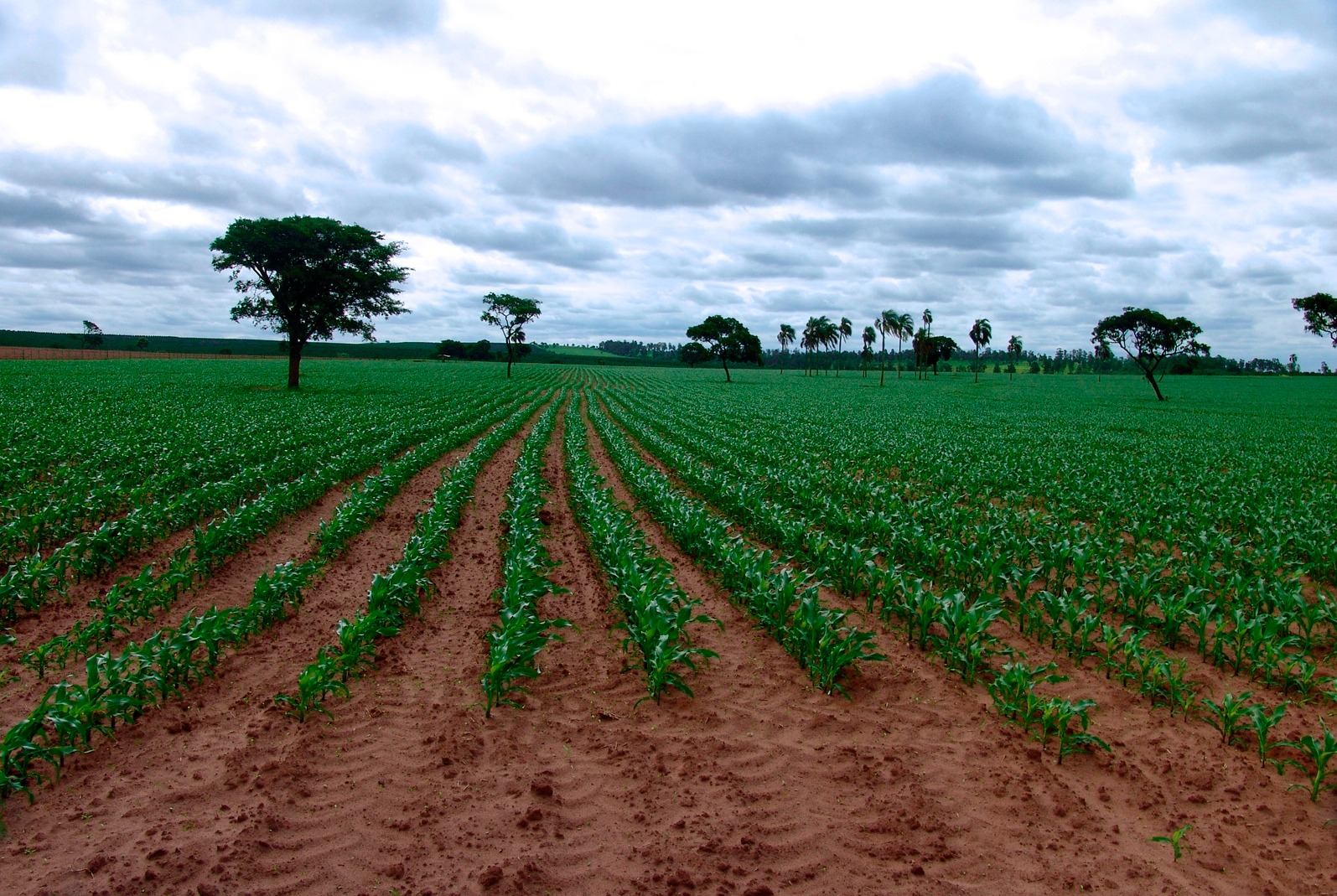
The white paper closes with a case study that puts its principles to the test. Drawing on work by Suzi Huff Theodoro, and Othon Leonardos, the paper describes community-based field trials in Brazil’s Central Plateau, where local farmers tested nutrient-rich volcanic rock dust from the Mata da Corda formation under real-world farming conditions. The study involved about 220 families in a community of roughly 1,000 people, and the trials were designed so farmers could compare rock dust, rock dust plus compost, synthetic NPK fertilizer, and combined treatments on crops such as maize, sugar cane, cassava, rice, and watermelon.
The application rates in those trials, 2.5 to 4 tonnes per hectare, were modest compared with some carbon-focused deployment scenarios discussed elsewhere in the literature. Yet the reported effects were substantial. Over two growing seasons, with a five-year follow-up, soils treated with rock dust and compost showed improved pH, higher levels of bioavailable calcium, magnesium, potassium, and phosphorus, and reduced aluminum toxicity. Water retention improved, and root systems were more extensive than in soils treated with NPK alone. The remineralized plots also produced higher yields, and because the improvements in soil fertility persisted over time, farmers reported input cost reductions exceeding 60 percent.
Just as important, the Brazilian case shows how soil remineralization can spread through farmer-centered learning rather than top-down prescription. Researchers provided technical guidance and materials, but farmers carried out comparisons themselves, discussed outcomes, and incorporated what they learned into broader community life. The study serves as more than an agronomic success story. It offers a model for linking remineralization to local knowledge, lower input dependence, and rural economic resilience.
A foundation for renewed discussion
The RTE white paper “Soil Remineralization in Agroecological Systems: A Critical Review” does something the field has needed: it consolidates five millennia of practice and nearly two decades of modern research into a single coherent framework, and in doing so, clarifies the terms of the debates surrounding it. It brings together observations from multiple perspectives, including scientists, farmers, and carbon finance experts, and highlights soil remineralization’s great potential, while also underscoring the need for restraint, sound design, and a whole-system approach. As an EarthArXiv preprint, the white paper remains open to comments, critique, and revision. But it already provides a substantial foundation for renewed discussion of how soil remineralization can contribute to global food security, nutrient density, climate resilience, and the restoration of living soils.
James Jerden is an environmental scientist and science writer focused on researching and promoting sustainable solutions to urgent environmental problems. He holds a Ph.D. in geochemistry from Virginia Tech and a Master’s degree in geology from Boston College. Over the past 20 years, James has worked as a research geochemist and science educator. He joined Remineralize the Earth because of their effective advocacy, research, and partnership projects that support sustainable solutions to urgent environmental issues such as soil degradation (food security), water pollution from chemical fertilizers (water security), deforestation, and climate change. As a science writer for RTE, his goal is to bring the science and promise of soil remineralization to a broad, non-technical audience. When not writing, he can be found at his drum set.
Support us on Patreon
Thank you for joining us today! Please become a member of RTE and support us on Patreon. Unlike many larger organizations, we work with a team of determined and passionate volunteers to get our message out. We aim to continue to increase the awareness of remineralization to initiate projects across the globe that remineralize soils, grow nutrient dense food, regenerate our forests’ and stabilize the climate – with your help! If you can, please support us on a monthly basis from just $2, rest assured that you are making a big impact every single month in support of our mission. Thank you!
- S Prev
- s


Got something to say?