
The Limits of a Great Idea: Basalt and Biochar in Rice

Photo by Aswathy N
A greenhouse experiment at Nanjing Agricultural University compared flooded paddy soil that was treated with basalt and biochar, on their own and together, against untreated. It set out to learn how enhanced weathering, studied mostly on dry land, performs under the permanent flooding of a rice paddy, and whether the two amendments do more together than apart.
Xueliu Gong and colleagues, writing in the Journal of Environmental Management, report that basalt on its own removed about 11 tonnes of CO2 per hectare through carbonate formation and raised rice yield by nearly 21%. Adding biochar lowered that carbon removal by roughly a quarter and brought the yield gain close to zero, though it cut methane and nitrous oxide far more than basalt did alone.
Rice paddies occupy less than a tenth of the world’s cropland but produce close to half of its agricultural greenhouse gases, most of that as methane rising out of waterlogged, oxygen-poor soil. They also feed nearly half the world’s population. Enhanced weathering, the practice of spreading crushed silicate rock to draw down CO2, has been tested mostly on dry fields such as the US Corn Belt, so how basalt behaves under permanent flooding was largely unknown. Biochar joined the experiment because it stores carbon for centuries on its own, and in earlier mesocosm trials it appeared to add to basalt’s effects.
Results
Basalt weathered quickly in the flooded pots, where standing water and low oxygen favored the dissolution and carbonate formation that locked carbon into the soil, and per tonne of rock it removed carbon faster than comparable studies report for dry cropland. The yield gain traced to silicon, the element rice uses to stiffen its stems against lodging and fill out its grains: basalt lifted grain silicon by 58%.
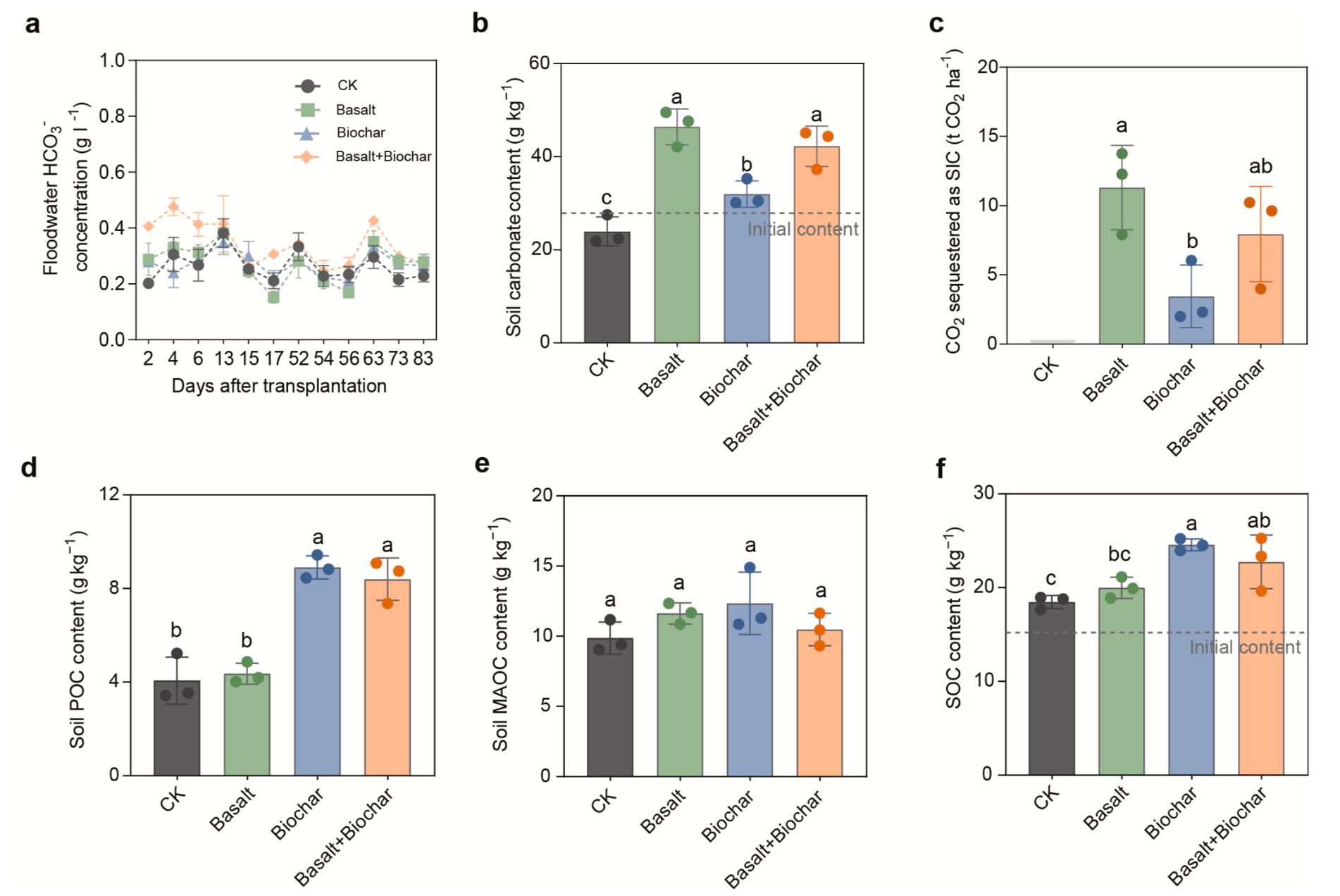
Adding biochar changed those results: net carbon removal, counting inorganic carbon together with the avoided greenhouse gases, fell from about 11.7 tonnes of CO2 per hectare under basalt to 8.8 under the pair, and the yield advantage shrank to about 2.5%. The biochar used — poplar wood shavings pyrolysed at 750°C with a large, porous surface — adsorbed the calcium, magnesium, and silicon released by the weathering basalt before they could benefit the plants or participate in carbonate reactions. At the same time, its high carbon-to-nitrogen ratio tied up soil nitrogen. Gong and colleagues attributed the weak results to this particular biochar, suggesting that a lower-temperature (less than 400°C) biochar made from straw or manure would soak up fewer of the nutrients released by the basalt and would probably not have suppressed the gains so sharply.
Methane dropped by about 31% given basalt and biochar together (versus 18% for basalt alone), and nitrous oxide decreased by roughly 52%, together lowering the crop’s greenhouse gas intensity by nearly 38%. The combination also encouraged soil microbes to complete denitrification, converting more of the nitrous oxide to inert nitrogen gas. Biochar left more carbon behind in durable form as well, raising stable organic carbon, and it shifted the fungal community toward faster-cycling species, increasing carbon stored by fungus by 21%. Biochar also decreased heavy-metal levels in the grain.
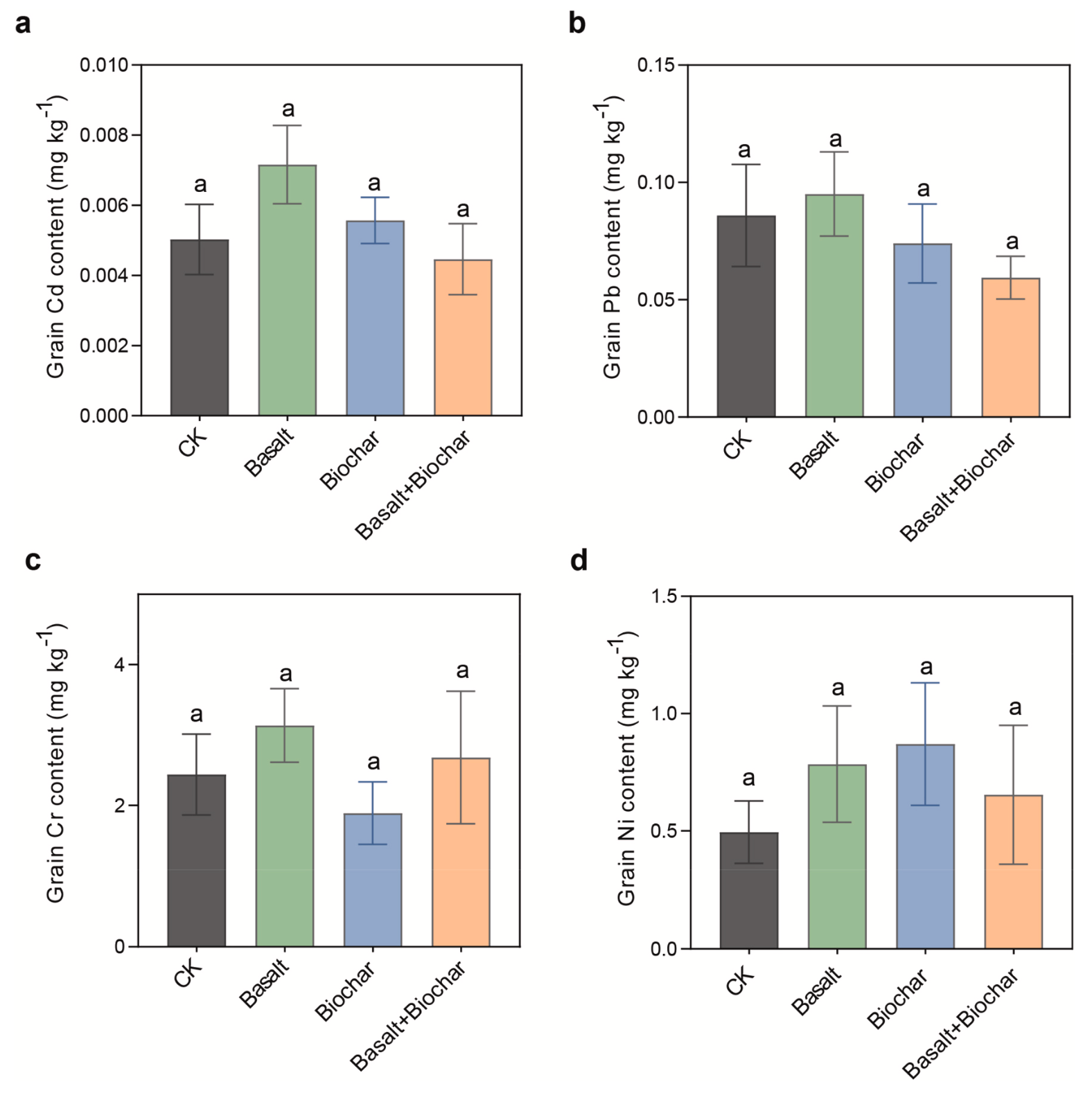
The basalt came from Xuyi, in Jiangsu, where the bedrock is naturally rich in nickel, chromium, and zinc, and grain from the basalt-only pots drifted upward in cadmium and lead. The increases were not statistically significant, which was expected, since this kind of increase tends to build up only under repeated application, and biochar’s metal-binding capacity brought the concentrations back down.
The quarter drop in carbon removal counted only inorganic carbon and avoided emissions, but left out the stable organic carbon biochar that builds up. With that included, biochar alone stores the most, about 44 tonnes of CO2 equivalent per hectare, the biochar and basalt combined store 37 tonnes per hectare, and basalt alone stores 22 tonnes per hectare.
Limits and what’s next
Gong and colleagues’ study was a pot experiment testing one soil, one biochar, and three conditions for a single season. From it, they conclude that the techniques could scale up to remove around 5 gigatonnes of CO2 equivalent from the atmosphere per year. This projection assumes basalt is spread across all 160 million hectares of the world’s rice paddies at the same rate as in the experiment rate, which is a large extrapolation from three pots. A study like this only establishes the chemistry and cannot reliably tell how much carbon a real paddy would actually store. Thus, field trials need to be taken across a range of soils and climates, with full life-cycle accounting.
The biochar that stores the most carbon is not always the one that facilitates the fastest basalt weathering or that feeds the crops best. The feedstock, the burning temperature, and the ratio of basalt to biochar all changed the results in the Nanjing studies. The practical question remains: which type of biochar should pair with basalt, and in what proportion?
Qi Zheng is an undergraduate student in Environmental Policy and Sustainable Development with Economics at the London School of Economics and Political Science. She is interested in climate policy, soil carbon sequestration, and sustainable land management, and is also exploring the intersections of environmental governance and economic development.
Support us on Patreon
Thank you for joining us today! Please become a member of RTE and support us on Patreon. Unlike many larger organizations, we work with a team of determined and passionate volunteers to get our message out. We aim to continue to increase the awareness of remineralization to initiate projects across the globe that remineralize soils, grow nutrient dense food, regenerate our forests’ and stabilize the climate – with your help! If you can, please support us on a monthly basis from just $2, rest assured that you are making a big impact every single month in support of our mission. Thank you!


Got something to say?