
Paydirt: Rock Dust, Rice, and a Smallholder’s Reward


During the 2024 monsoon season, carbon removal company Mati Carbon spread close to 40,000 tonnes of crushed basalt across more than 8,000 rice paddies in central India. The rock was quarry waste from a short drive away. By harvest, the treated farms had something to show in two currencies at once: more rice, and removed carbon.
Mati Carbon, based in Houston, won the $50 million XPRIZE Carbon Removal grand prize in April 2025 for this practice. A new preprint, Jordan et al. (2025), reports the first commercial-scale evidence that enhanced rock weathering (ERW) can raise smallholder yields and remove measurable carbon in the same season.
In previous reporting on cacao agroforestry last year, we noted that companies like Mati, Flux, and InPlanet absorb the upfront cost of rock dust in exchange for carbon credits. This study is the first attempt to put numbers on whether that bargain holds at scale.
Smallholders grow roughly a third of the world’s food, much of it on acidic, nutrient-poor soil they cannot afford to repair. They often harvest only about half of what larger, better-capitalised farms manage under similar conditions.
The Deployment
The work took place during the Kharif season of 2024 in the Gaurela-Pendra-Marwahi district of Chhattisgarh: 636 farmers across 36 villages, covering more than 800 hectares. The basalt came as waste fines from local aggregate quarries cutting into the Deccan Traps, one of the largest and most accessible basalt formations on Earth. Sourcing rock that close to the fields keeps transport emissions low, the same logistical advantage that makes tropical volcanic regions attractive for ERW. The hot, wet monsoon does the rest, since weathering accelerates with heat and water. Applications averaged about 45 tonnes per hectare on the region’s moderately acidic Alfisols.
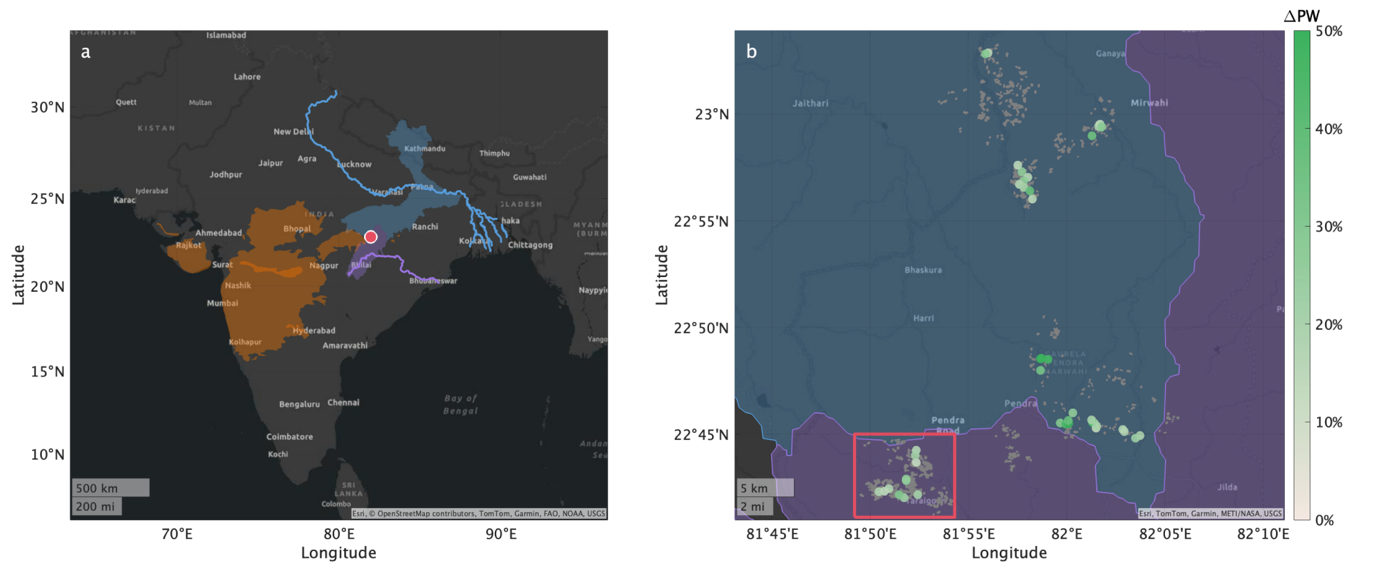
To measure the results, the team used two independent methods. First, on 44 farms, they harvested paired plots, one treated with basalt and one left as usual under otherwise identical management, and weighed the grain directly. In addition, they surveyed 594 farmers about their own harvests.
On the measured plots, basalt raised paddy weight by a median of 22.9%, with most farms seeing an increase between 17.5 and 30.9%. The effect was statistically robust. In monetary terms, the median farmer gained roughly $303 in a single season, close to a fifth of the region’s average annual household income.
As the basalt dissolved, it released its minerals into the soil, and for rice the most consequential was silicon, an element the crop uses to stiffen its cell walls and resist blast, the fungal disease that strips paddy yields across the tropics. Each hectare took up roughly 2,700 kilograms of it. The rock also released about 27 kilograms of potassium per hectare, close to half the rate Indian agronomists recommend for wetland rice. It also served as a liming agent, neutralising acidity to the equivalent of roughly four tonnes of agricultural lime per hectare, and while ordinary lime only adjusts pH, the basalt corrected it and provided several nutrients at the same time.
The farmer surveys back up these results, within their limitations. Surveys are noticeably noisier, as farmers report harvests to the nearest 100kg, so the same rounding error balloons into a large percentage on a small plot. The authors are candid that the survey data are useful for gauging reach and adoption rather than fixing the exact size of the effect.
The Carbon Side
Carbon removal was inferred from the soil itself. Because titanium barely moves during weathering while calcium and magnesium wash out, the ratio between them tracks how much of the applied rock has dissolved. By that accounting, about 27% of the basalt weathered in the first year, yielding roughly four tonnes of CO₂ removed per hectare. Across the 620-acre study area that comes to nearly 1,000 tonnes; scaled to the full deployment, more than 3,000.
The authors flag one qualifier: this is an initial, gross figure, measured before subtracting the carbon lost as bicarbonate travels downstream and re-equilibrates in the ocean. It is the ceiling of what the season removed instead of the final ledger.
The yield gain and the carbon removal are treated as two distinct products, and only the carbon is sold. Climate finance, paid by purchasers of carbon credits, covers the cost of sourcing, grinding, spreading, and monitoring the rock. Mati Carbon’s verification leans on field-deployed mass spectrometry, the data-heavy monitoring that caught the XPRIZE judges’ attention, which is what allows the carbon to be credited. The farmer pays nothing and keeps every rupee of the extra harvest.
A farmer on thin margins may be reluctant to invest in rock dust with an uncertain carbon return. Taking over the financing from the farmer removes this barrier to adoption.
Valued at a social cost of $185 per tonne, the carbon removed across the 620-acre study area is worth close to $190,000. The same season’s yield gains added about $214,000 to the participating households.
“Establishing these outcomes demonstrates a replicable pathway for climate-financed agricultural development.” —
Jordan et al. (2025)
Looking ahead
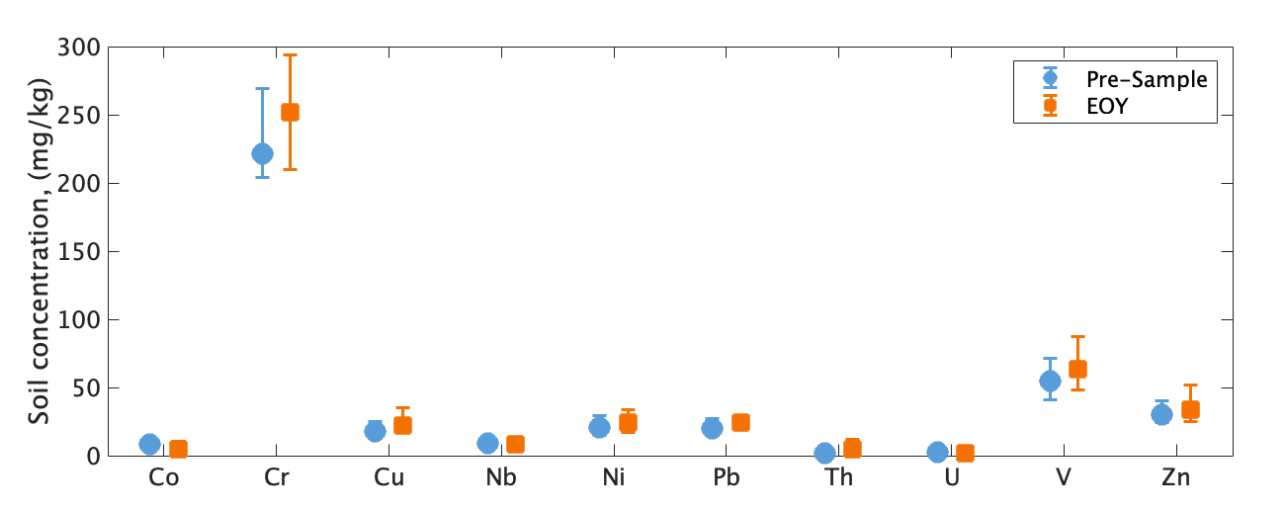
One monsoon is a beginning. The toxic-metal results are reassuring: no measurable buildup of nickel, chromium, or cadmium in grain, straw, or soil after a single application. But the tissue samples were relatively few, and one season by itself can’t tell us what a decade of repeated applications might do.
The deeper timing question remains as well. Cations released by weathering can sit on soil exchange sites for years before the carbon is locked away as bicarbonate, which means the drawdown a credit represents may lag the season it is claimed for. Closing that gap is what this kind of field accounting will have to do.
The trajectory the authors sketch is striking. They cite projections that the share of ERW carbon removal coming from low- and lower-middle-income countries could climb from about a quarter in 2040 to three-fifths by 2100. The growth tracks the spread of the practice into the warm, wet regions where it works best.
If that pattern holds, the importance of a single monsoon in Chhattisgarh lies in the template it proves. It is a model for how climate finance from the Global North can restore soil and lift incomes in the Global South, with the carbon and the harvest kept on separate books. The rock under these paddies has always weathered slowly, releasing its minerals to whatever grows above. What is new is that someone is now paying for it to happen faster, and the farmers are not the ones footing the bill.
Qi Zheng is an undergraduate student in Environmental Policy and Sustainable Development with Economics at the London School of Economics and Political Science. She is interested in climate policy, soil carbon sequestration, and sustainable land management, and is also exploring the intersections of
Support us on Patreon
Thank you for joining us today! Please become a member of RTE and support us on Patreon. Unlike many larger organizations, we work with a team of determined and passionate volunteers to get our message out. We aim to continue to increase the awareness of remineralization to initiate projects across the globe that remineralize soils, grow nutrient dense food, regenerate our forests’ and stabilize the climate – with your help! If you can, please support us on a monthly basis from just $2, rest assured that you are making a big impact every single month in support of our mission. Thank you!


Got something to say?