
The Future of Carbon Removal is Enhanced Rock Weathering: Introducing the Everest Pulsar
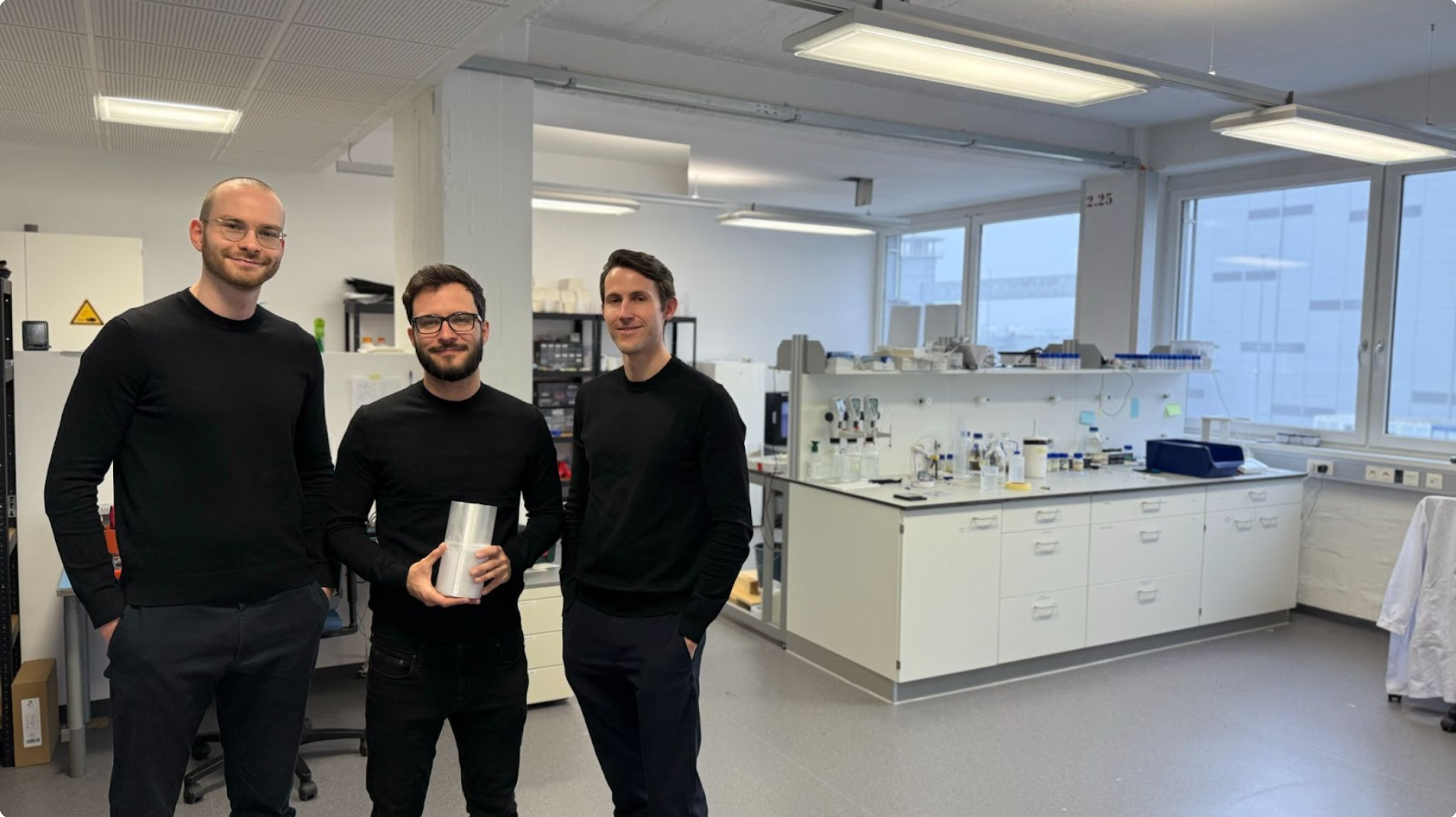
Co-Founders Jonte Boysen (left), Dr. Matthias Ginterseder (middle), and Pascal Michel (right) at Everest’s R&D facility in Linz with an early prototype of the company’s sensor. Source: Everest Carbon, https://www.everestcarbon.com/resources/announcing-the-erw-sensor.
When developing climate change solutions, one may look to Mother Nature for inspiration. Pascal Michel founded Everest Carbon in 2022 with the goal of using enhanced rock weathering (ERW) techniques to accelerate naturally occurring carbon sequestration. Everest is a carbon removal company that sells carbon credits to buyers seeking to offset their emissions and allows buyers to track their investment in real time, ensuring transparency in every purchase.
Carbon removal naturally occurs in the soil. Carbon dioxide in the air mixes with rainwater to form carbonic acid, which then dissolves the silicate minerals in the soil to release base cations and create bicarbonate. The bicarbonate precipitates as mineralized carbonate, which travels through surface and groundwater to eventually flow into the ocean to be stored in marine sediments. Through these processes, the soil helps to naturally reduce greenhouse gases in the atmosphere.
ERW is a way to speed up this process. By incorporating fine particles of rock dust, like basalt, into the soil, there is a greater surface area for carbon dioxide to interact with, chemically speeding up the storage process and making it possible to quickly capture greater quantities of carbon.
One of the greatest challenges facing ERW within the strategy of using carbon credits as a climate change solution is the difficulty to efficiently and accurately measure the amount of carbon captured from the air and retained in the soil. This was the harsh reality facing Michel and his fledgling company. After deploying 300 tons of rock dust in India for the first of the company’s creditable projects, it became clear that Everest lacked an efficient method of measurement. Without a reliable way to quantify the carbon removal, proof of Everest’s success would be minimal at best.
Everest’s answer for reliable measurement
One method for quantifying sequestered carbon is by measuring total alkalinity. Because the carbonate travels some distance via water channels, the levels of alkalinity in any given location are constantly changing. Traditional methods of soil sampling test one data point at a single moment in time, meaning that each sample is reflective of the water passing through that data point at that specific moment of sampling. Because water moves through soil over time, any sample can be vastly different from another taken minutes or hours later. To effectively capture total alkalinity, measurement must be constant.
Additionally, the single data point surveyed in traditional soil sampling provides only a small glimpse of the total alkalinity of the soil. To get a more complete picture, multiple locations must be sampled, requiring more time and labor. Simply put: for the business to succeed, Everest needed a more efficient measurement system.
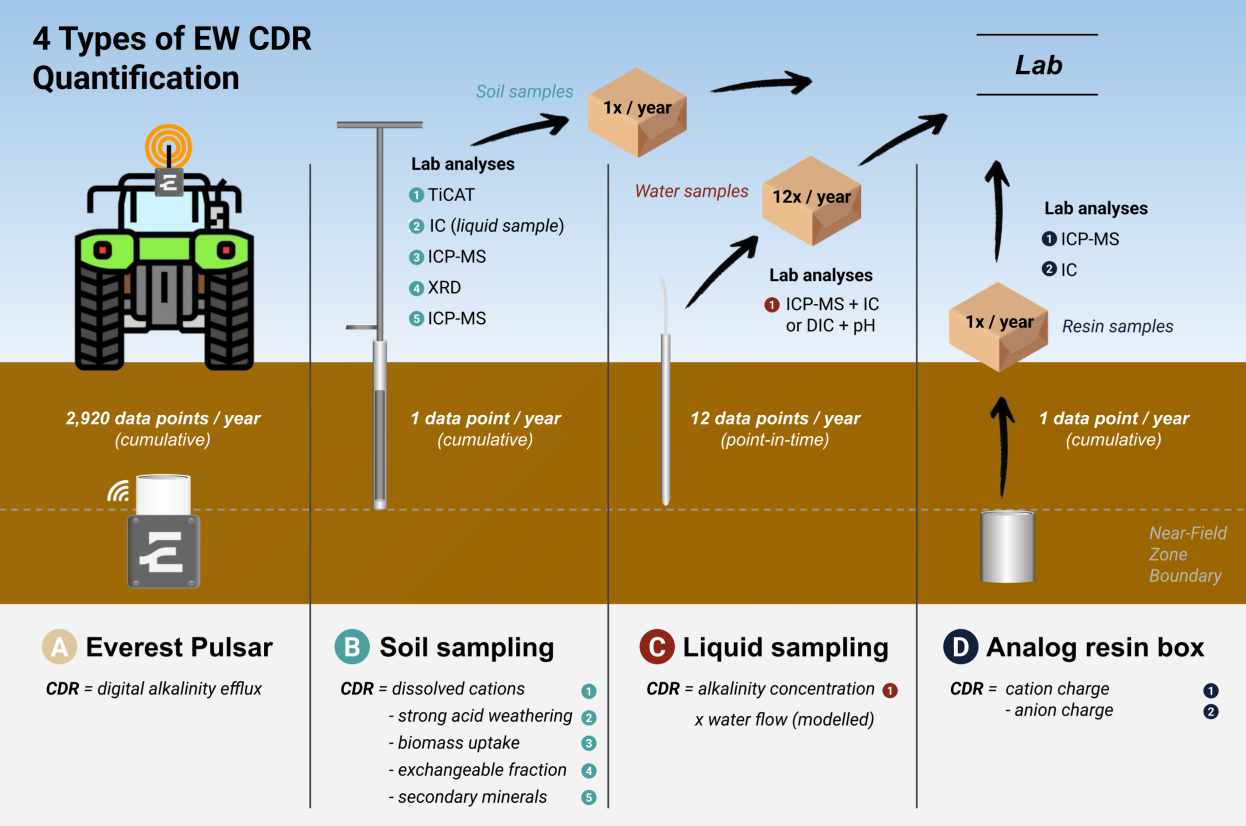
To truly get an answer as to the efficacy and marketability of ERW as a method of carbon removal, Michel recruited former MIT research chemist Matthias Ginterseder. Together, they designed the Everest Pulsar, an alkalinity sensor that focuses on monitoring, reporting, and verification (MRV) for ERW. The Pulsar measures the total alkalinity of water leachate as it passes through the sensor by using weak acid resins to capture cations contributing to the water’s alkalinity. A digital reading of the total alkalinity is available in real time, making it possible to remotely monitor the effects of ERW.
Where traditional soil sampling can only survey 1 data point per year, the Pulsar surveys a cumulative 2,920 data points. This allows the Pulsar to operate across large areas without the added labor of manually surveying thousands of individual data points. Not only is this a faster and more cost-effective alternative, but, if accurate, the Pulsar could provide a more detailed accounting of the soil’s changing total alkalinity.
Michel put his sensor to the test in a 2025 internal study that assessed the device’s efficacy. Over a period of seven days, 19 sensors (10 without soil, 5 with soil, and 4 dummies) monitored continuous alkalinity flux driven by constructed pumps at a flow rate typical of loamy sand soils. The study indicated early signs of success, with sensors demonstrating high capture efficiencies of 98.9% without soil and 97.7% with soil. These digital readings were consistent with the chemically retrieved total alkalinity, having an average deviation of -0.3%, evidencing the high accuracy of the sensors.
If replicable, the results of this internal study indicate potential for the Pulsar to be a valuable tool in the carbon capture industry.
The future of carbon removal
Although more testing on the Pulsar is necessary to prove its reliability as a method of quantifying carbon removal, the initial study performed by Michel and his team demonstrated its potential as a cost-effective and efficient alternative to traditional soil sampling. This technology has the potential to transform the carbon removal industry by making it easy for potential investors to see the viability of ERW-accelerated carbon capture. More buyers means more carbon sequestered, reducing the greenhouse gases in our atmosphere. Looking to the future, the development of new technologies like the Everest Pulsar will propel us forward in refining and improving climate change mitigation strategies.
Caelyn Radziunas is an attorney based in New Orleans, where her practice includes toxic tort litigation. In addition to her J.D. from Tulane Law School, she holds a B.S. in Wildlife Biology from the University of Vermont. Caelyn focuses on the application of scientific knowledge to environmental law and policy for the benefit of vulnerable communities and ecosystems.
Support us on Patreon
Thank you for joining us today! Please become a member of RTE and support us on Patreon. Unlike many larger organizations, we work with a team of determined and passionate volunteers to get our message out. We aim to continue to increase the awareness of remineralization to initiate projects across the globe that remineralize soils, grow nutrient dense food, regenerate our forests’ and stabilize the climate – with your help! If you can, please support us on a monthly basis from just $2, rest assured that you are making a big impact every single month in support of our mission. Thank you!


Got something to say?